The right tool for the job - Shutdowns and Turnarounds
Shutdowns, turnarounds and outages (STO) pertain to extended maintenance periods during which the operation or production of critical asset(s) ceases or is at a reduced capacity. The constraints, requirements and objectives are known, but the schedule's build and solve process is largely manual which can only leave value on the table.
Major drivers in the space
- Safety - High-risk work and its impact on surrounding workfronts should never be overlooked in shutdown scheduling. The safety interactions of high-risk work vary depending on the nature of the work, the site and the layout of its infrastructure.
- Value - Direct cost of shutdown or turnaround events range from $5M to well above $100M in labour and materials. STOs consume 33-50% of an operation's annual maintenance budget on average and 5-10% of a site's production value can hinge on their performance1. The opportunity cost of overrun and measures to de-risk this potential should be considered in shutdown strategy.
- Volume - Hundreds of orders translates to thousands of activities, built into a range of systems and operational targets and distributed across dozens of resources. Shutdowns and turnarounds are observed to have on average a 19% growth in scope between scope freeze and execution2. Scope control and modelling impact to resources is key to shutdown success as this growth is typically not mirrored in the budgeted expenditure or duration.
- Compounding complexity - Isolations, systems, and commissioning windows are largely interdependent and can grow in operational requirements with a drifting scope. With many moving parts such as these interdependencies, safety considerations and resource utilisation, the variability in the solution space quickly becomes astronomical. The integrity of the schedule becomes harder to maintain and becomes exposed to logical decay as the scale and need for more personnel to maintain the model increase.
The typical compromises made
Safety outside of the solve
Generic solvers applied in STOs are blind to safety considerations and rely on manual evaluation and monitoring to coordinate. This process is inefficient, exposes a risk of 'uncoordinated' interactions and bakes in decisions that may hide an ultimately better and safer schedule. With many moving parts, relative workflows can drift, introducing new safety interactions into a manual solution space.
Heuristic levelling
Resource levelling as accepted by the industry is best described as a rule-of-thumb single pass that pushes work to the right across a project's timeline. It only considers logical relationships and resource limits and does not search beyond the first legal solution returned by the basic ruleset. No objective, no search and no proof. Industry analysis observes that this approach to levelling can drive project durations 10-50% longer than needed3. For project scheduling problems loaded with only 4 resources and 30 activities, the optimum is outside of the potential solution shape of a push-right pass 40% of the time4. For projects at a shutdown scale, an optimal solve is never expected to be reachable with a push-right pass.
Multi-disciplinary tasks
Activities requiring an assembly of trades and equipment at different durations requires compromise that departs from reality. Either allow the simple leveller to separate partial assignments of that multidisciplinary task, producing inexecutable plans; or assigning resources at an incongruous rate, presenting understated impacts to a resource's requirement demands.
Resource storage
Existing industry software stores resources and their limits centrally at an enterprise level. This introduces complexity, effort and manual approaches to explore the value of solving scenarios with varying resource capacities and profiles. 50% of shutdowns and turnarounds change their starting date at least once5 and realigning resources is performed manually.
Rate of planned work
Common pitfalls that overlook constraint or leave value behind emerge when further capacity constraints and utilisation opportunities are not recognised in the model. Resourcing requirements hidden beneath its strict limit, such as permit-holding capacity or leading hand presence, are often overlooked or manually evaluated and maintained. Lack of consideration for trade capabilities can result in over-utilisation and under-utilisation where trades are not correctly mapped to the works they are intended and capable of completing.
High effort workflows and software
Conventionally applied software is generalised to cater to all types of project scheduling and holds no domain knowledge for STOs. This versatility drives complexity in aligning and operating it to the best practical shape for shutdowns. Building, solving, maintaining and reporting from tools of this nature require a range of meticulous Excel mechanics to harness a level of efficiency in building, solving, communicating and executing shutdown schedules. The complexity and range of processes and checks results in a specialised class of shutdown schedulers.
Improvements not sustained
Sites fall under the impression that better practice should be observed event-on-event as familiarity improves and lessons are learned. Often, core items feature on multiple post-event registers because the problem is structural. Shutdowns are typically shaped as a nominal number of events per annual cycle and each schedule is built and solved to the minimum requirements of that event. The modelling of plants' operational requirements, their system interactions, intrusive requirements and commissioning is mapped for the event's scope only. Contracting is a common application in shutdown planning and scheduling roles due to specialised demand and non-constant project shape. This environment drives a more transient workforce and the value they've established on a shutdown often departs with their engagement.
Upgrading the approach
The Ponco Shutdown Scheduler, PS2, has been scoped and purpose-built for applications in shutdowns, turnarounds and outages and made with versatility to adapt to your operation. This is achieved by applying the four components of mathematical optimisation to a shutdown:
- The model - systems, isolations, phases, locations, resources
- The variables - scope, logic, solve parameters
- The objectives - minimise target overrun, minimise overallocation, minimise project makespan
- The constraints - safety in execution, resource constraints, target windows
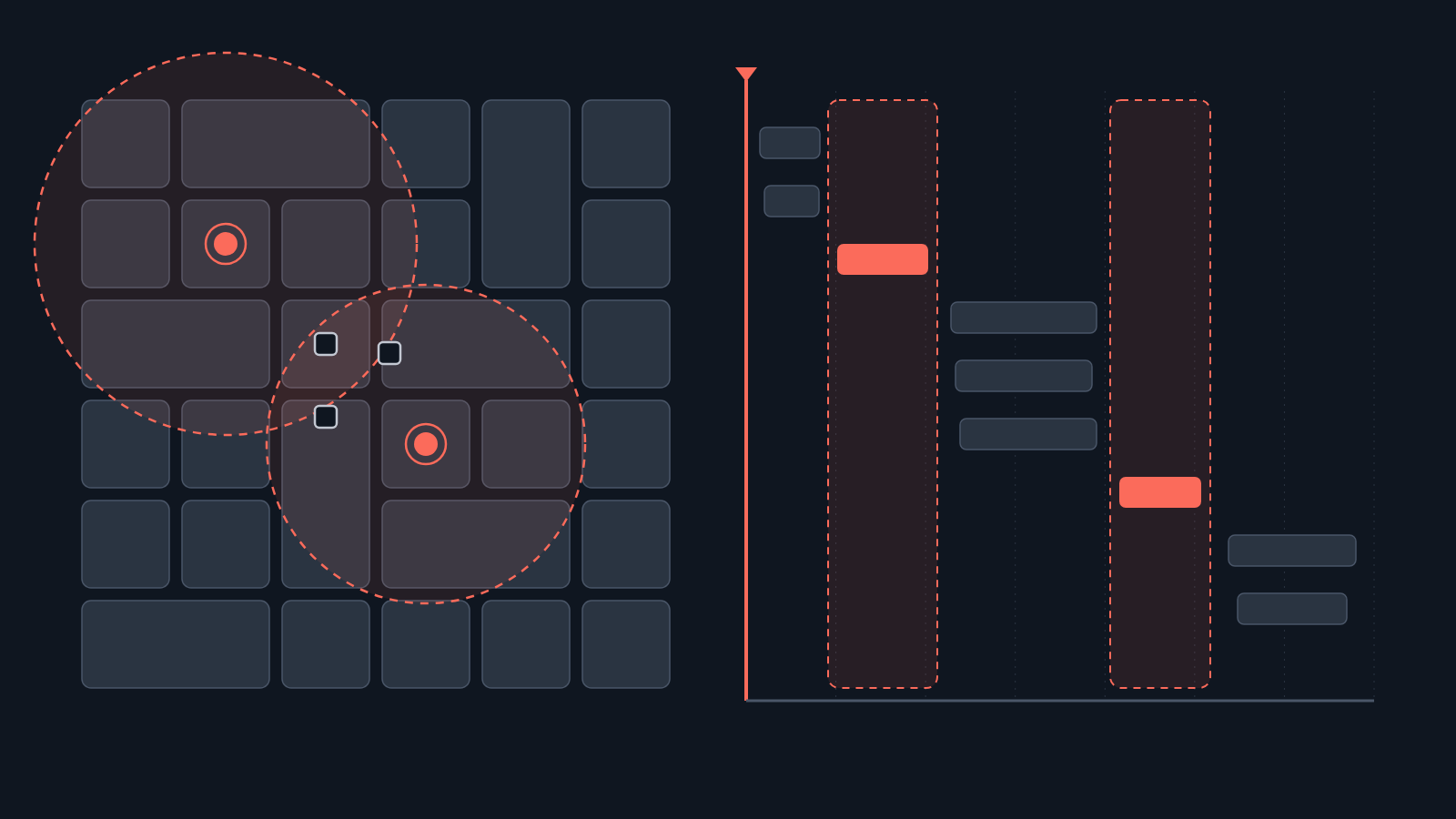
High-risk work is modelled, not annotated. Separation of high-risk work is modelled by risk type and proximity mapped on the model's digital twin, served to the optimisation engine. Conflicting high-risk activities are never scheduled to clash and every re-solve preserves this separation without the need to flag a logically bounding relationship. An optimal schedule is a safe schedule by design.
Multi-disciplinary tasks
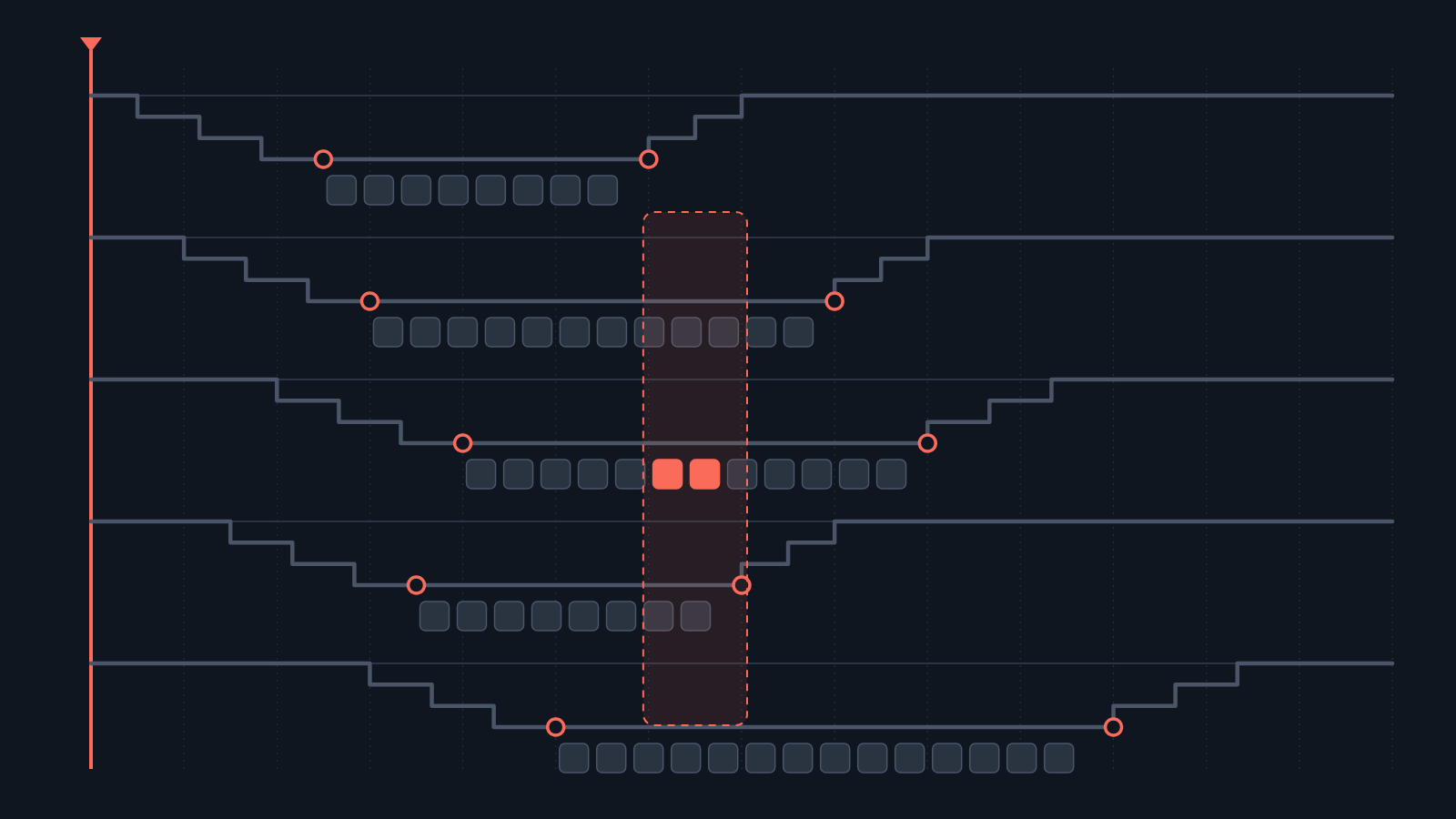
PS2 features suboperation mechanisms for tasks with a shared requirement for multiple resources. They are considered together and solved to satisfy this requirement. The fitter, the crane and the rigger required to complete the work move together to reflect the real requirements of the work. Multi-disciplinary tasks are never levelled apart.
Scenarios at pace
A flexible scenario system allows operations to easily assess the opportunities or consequences of adjusting an input, and the resulting impact it drives to your planned shutdown. Answer every what-if with speed and ease.
Effort reduction
The level of effort and complexities required to build and execute shutdown schedules is massively reduced using PS2's approach to shutdowns. Ponco establishes your infrastructure, systems and resources, then deploys a robust framework allowing your personnel to build shutdown schedules efficiently. Safety separation and resource utilisation are resolved inside the solver engine. Features snap to the expected response for common datasets and workflows. Repetitive workflows run in batch - full PDF reporting sets, resource data and dashboards - the software produces all reporting requirements at presentation quality and regenerates post-solve.
Unlock the potential of your resources
Understanding the nature of the resource and its utilisation pattern is key. PS2 breaks resources down to a finer level of detail to map and solve for realistic resourcing patterns and shapes suitable for STO implementation. Resource limits are satisfied with better utilisation rates provided by an optimal solve which considers a greater extent of possibilities. Overallocations are spread rather than stacking into a bow wave for better management of underperformers. Second stage crew-solves are modelled for critical resources to consider resource constraints outside of the limit. Groupings of resource and equipment can be specified to better utilise your available qualifications and capacity-rated equipment.
A model that grows
The methodology, guidelines and domain knowledge are embedded in the software to remain on site and applicable for re-use. The process is made consistent and accessible such that suitable planners, schedulers, engineers and operations personnel can be effective contributors as operators of the software. Site data, resource configurations, system templates and order history persist beyond events and each completed event leaves the model richer than it found it. The value of the scheduling investment remains with the site.
Where to start
Feasible is where the industry paused. Optimal is where the solver starts. If the compromises identified above ring true for your site, get in touch today to see what an upgraded approach to scheduling could look like at your operation.